When welding metal components for electrical applications, joint quality determines both mechanical strength and electrical conductivity — two factors that directly impact finished product reliability and service life. As a dedicated Pulse Energy Storage Welding Machine for Metal Components, the Feihong® FH-149A addresses these requirements through controlled capacitor discharge pulse technology, making it one of the standard production machines used by heating pipe manufacturers. Built by Zhaoqing Feihong Machinery & Electrical Co., Ltd., a manufacturer with decades of history producing complete electrical heating tube equipment lines, this pneumatically operated machine handles the two critical metal component joining operations at the heart of every heating element: resistance wire to lead post connections and lead post to terminal lug connections.
Machine Definition
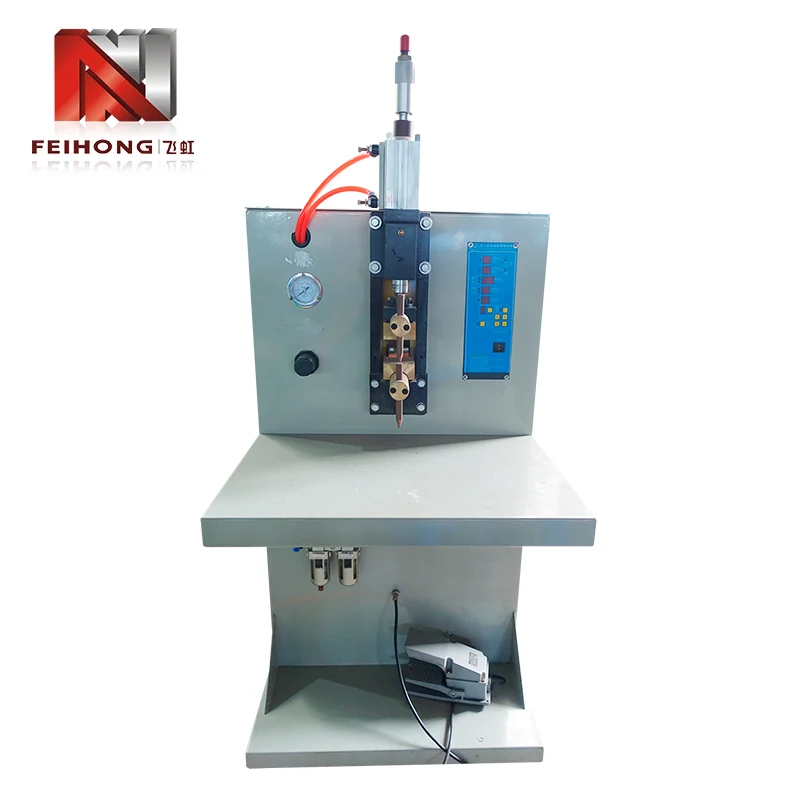
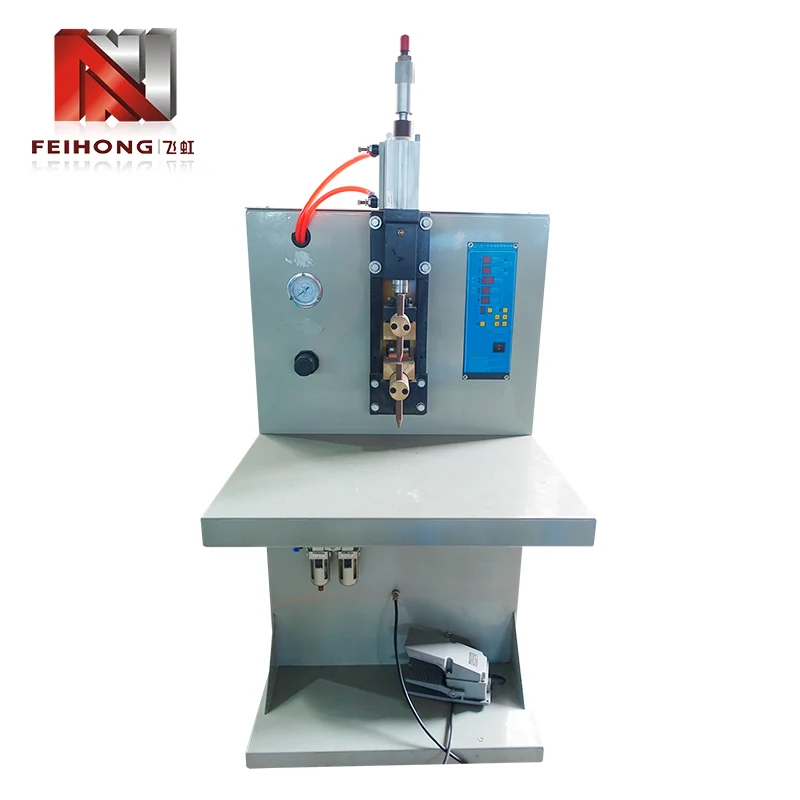
The FH-149A is a pulse-type energy storage welding machine designed for joining small metal components in electrical heating element manufacturing. It falls into the broader category of resistance spot welding equipment but uses a capacitive energy storage architecture rather than drawing welding current directly from the AC mains supply.
In operation, the machine first charges an internal capacitor bank to a preselected voltage level. When the weld cycle is triggered, the stored electrical energy is discharged in a single, short-duration pulse through the welding electrodes and the workpieces. The electrical resistance at the interface between the two metal components generates localized heat, melting a small volume of material that then cools to form a solid weld nugget joining the parts together.
This pulse-based energy delivery is particularly advantageous for small metal component welding because the heat input is brief and highly localized. For thin resistance wires and relatively small lead posts, the short pulse prevents excessive heat from spreading along the components, reducing the risk of material damage, distortion, or changes to material properties outside the immediate weld zone.
Pneumatic actuation controls electrode movement and applies consistent clamping force during each weld cycle. Proper and repeatable force is essential because it determines the contact resistance between electrode and workpiece, and between the two metal components being joined — both of which directly influence how heat is generated and how the weld nugget forms.
Welding Performance
As Pulse Energy Storage Welding Machine for Metal Components, the FH-149A delivers performance characteristics tailored to the specific metal joining tasks found in heating tube manufacturing:
1. Controlled Pulse Energy: Capacitor charging voltage is adjustable from 0 to 435V, giving operators precise control over the total energy delivered in each welding pulse. This adjustability allows optimization for different component sizes and material combinations.
2. Consistent Joint Quality: Because weld energy is drawn from pre-charged capacitors rather than directly from the power line, pulse-to-pulse energy consistency is high, resulting in uniform weld quality across production batches even when line voltage experiences minor variations.
3. High Production Throughput: Rated production capacity reaches 30,000 pieces per 8-hour operating shift, making the machine suitable for both medium and high-volume metal component assembly operations in heating tube manufacturing.
4. Pneumatic Pressure Repeatability: Pneumatic electrode actuation delivers highly consistent downward force on every cycle, eliminating the variability inherent in manually operated welding setups and contributing to overall weld uniformity.
5. Low Average Power Demand: Despite delivering high peak welding current, the energy storage architecture means average mains power draw is only 2 KVA, reducing electrical infrastructure requirements and operating cost per weld.
Technical Parameters
The following table summarizes the official technical specifications for the FH-149A pulse energy storage welding machine:
|
Parameter
|
Specification
|
|
Model
|
FH-149A
|
|
Machine Type
|
Pneumatic Pulse Energy Storage Spot Welding Machine
|
|
Input Voltage Options
|
Three-phase 380V / Three-phase 220V / Single-phase 220V
|
|
Rated Power
|
2 KVA
|
|
Capacitor Voltage Range
|
0 to 435V (continuously adjustable)
|
|
Drive Method
|
Pneumatic
|
|
Production Output
|
30,000 pieces per 8-hour shift
|
|
Primary Applications
|
Resistance wire to lead post; Lead post to terminal lug
|
The multi-voltage input capability allows the same machine model to be deployed in manufacturing facilities with different electrical supply standards across various countries, simplifying procurement for manufacturers with multiple international locations.

Metal Component Applications
Within heating tube manufacturing, the machine performs two primary metal component welding operations, each essential to finished heating element function.
Resistance Wire and Lead Post Assembly
Inside every electrical heating tube, resistance wire serves as the heat-generating element, while lead posts (also called lead bars) serve as the conductive pathway connecting the wire to external electrical terminals. The welded joint between these two metal components must combine good mechanical strength with low electrical resistance. The FH-149A produces these joints with the consistency required for reliable heating element performance over the product service life.
Lead Post and Terminal Lug Connection
At the ends of the heating tube, lead posts connect to terminal lugs — the metal components that form the external electrical connection points of the finished heater. These joints must withstand both mechanical stress during installation and thermal cycling during normal operation. Pulse energy storage welding creates robust, metallurgically bonded joints that hold up under these real-world operating conditions.
Broader Industry Context
Heating tubes produced using this equipment are used across both industrial and civilian sectors. Industrial applications focus heavily on cable heating systems, while civilian applications cover household electrical appliances and daily consumer heating products. Feihong equipment supports manufacturers that supply heating elements to both of these market segments.
Build Quality
Feihong manufactures the FH-149A in its Zhaoqing, Guangdong facility using a vertically integrated production approach that spans six dedicated workshop areas. This integrated manufacturing structure enables systematic quality control throughout the equipment build process.
1. Raw Material Preparation: The raw material cutting workshop handles initial metal stock preparation, establishing the baseline material quality for machine components.
2. Precision Machining: The machining center produces critical mechanical components to required dimensional specifications, ensuring proper fit and function in the assembled machine.
3. Tool and Mold Making: The in-house mold production workshop manufactures custom tooling, jigs, and fixtures used in both equipment production and, where applicable, customer-specific process requirements.
4. Specialized Equipment Areas: Separate dedicated workspaces exist for powder filling equipment and pipe shrinking machine assembly and calibration, reflecting the breadth of the Feihong heating tube equipment product range.
5. Final Assembly and Testing: The machine assembly workshop is where completed components come together into finished machines, undergo functional testing, and receive final quality verification before being prepared for shipment.
Since founding in 1992, Feihong has applied this manufacturing structure to develop and produce many types of electrical heating tube equipment, including standard production models as well as numerous specialized machines developed to meet specific customer requirements.

Value Proposition
For manufacturers evaluating Pulse Energy Storage Welding Machine for Metal Components, the Feihong FH-149A offers distinct value beyond the basic welding function.
Because Feihong focuses exclusively on heating tube manufacturing equipment rather than producing a broad range of general industrial welders, the company brings deep, application-specific knowledge to every machine it builds. The FH-149A is not a repurposed general welder — it is designed from the ground up for the exact metal component joining operations that heating element manufacturers perform every day. This application focus translates into machines that fit naturally into production workflows with minimal adaptation.
Feihong also brings proven custom development capability. Over the years the company has successfully developed specialized heating tube equipment for industrial, civil, hot runner, and even aerospace and military applications. For manufacturers with unique metal component configurations or non-standard production requirements, this in-house R&D capability means the supplier can grow with evolving production needs rather than requiring a change of equipment vendor.
Additionally, Feihong operates on principles of quality assurance and integrity, and actively encourages customers to visit the factory directly. Being able to see the manufacturing facility, inspect finished equipment, and discuss technical details face-to-face with engineering staff gives buyers confidence in both the product and the supplier relationship.
Procurement FAQ
Q: What metal components can this machine weld together?
A: The FH-149A is specifically configured for two metal component joining operations in heating tube manufacturing: welding resistance wire to lead posts (lead bars) and welding lead posts to terminal lugs. These are the standard internal connections inside electrical heating elements.
Q: How does pulse energy storage welding work for metal components?
A: The machine first charges internal capacitors to a selected voltage, then releases that stored energy in a single short pulse through the electrodes. The electrical resistance between the metal components generates localized heat that forms a weld nugget, joining the parts together. The short pulse duration keeps heat concentrated at the joint.
Q: Can weld energy be adjusted for different metal component sizes?
A: Yes, the capacitor charging voltage is fully adjustable from 0 to 435V. This allows operators to increase or decrease the total pulse energy to match different wire gauges, lead post diameters, and terminal lug thicknesses across the range of components produced on a manufacturing line.
Q: What production volume can this machine support?
A: Under standard operating conditions, the FH-149A has a rated production capacity of 30,000 pieces per 8-hour shift. Actual output depends on factors including operator experience, component preparation workflow, and the specific product being assembled.
Q: What electrical supply does the machine require?
A: The FH-149A supports three input voltage configurations: three-phase 380V, three-phase 220V, and single-phase 220V. This flexibility enables deployment in manufacturing facilities with different electrical infrastructure standards across multiple countries.
Q: Can I visit the Feihong factory to evaluate the equipment?
A: Yes, Feihong welcomes prospective customers to visit the factory in Zhaoqing, Guangdong, China. During a visit you can inspect completed machines, tour the six production workshops, and discuss technical requirements directly with the engineering team.

Concluding Notes
For metal component assembly in heating tube manufacturing, the Feihong FH-149A provides a purpose-built Pulse Energy Storage Welding Machine for Metal Components that combines precise pulse energy control, consistent pneumatic actuation, and production-proven reliability. With adjustable output across the 0 to 435V range and a rated capacity of 30,000 pieces per shift, the machine handles both resistance wire-to-lead-post and lead-post-to-terminal-lug welding operations with the quality consistency that electrical heating element production demands. Manufactured in Feihong's six-workshop integrated facility by a company with more than 30 years of heating tube equipment specialization, the FH-149A represents both solid welding performance and a stable, knowledgeable equipment supply relationship. Whether setting up a new heating element assembly line or replacing existing welding stations, manufacturers benefit from working with a supplier that understands their specific production process end to end.
Feihong welcomes technical inquiries, detailed specification requests, and factory visit arrangements from manufacturers evaluating welding equipment for metal component assembly applications.
Request Detailed Specifications